What Affects the Cost of Roof Cleaning in Wrexham?
If you've been looking up at your roof and wondering why one quote lands so differently from the next, you're not alone. Roof cleaning isn't a fixed-price job, and the number you're given depends on what your particular roof actually needs. Two houses on the same Wrexham street can carry very different costs, even when they look almost identical from the pavement.
So before you compare figures, it helps to know what a cleaner is actually looking at when they work out a price. Once you understand the factors, the quotes make a lot more sense, and you can tell a fair one from a rushed guess. Here's what really moves the price on a roof clean around Wrexham and the wider North Wales area.
The quick answer: The cost of roof cleaning depends on the size and pitch of your roof, the type of covering, how much moss and algae have built up, how easy the roof is to reach safely, and whether you need extras like gutter clearing or a biocide treatment. Nobody can give you an honest figure without seeing the roof first.
1. The size, pitch and shape of your roof
The bigger the roof, the more surface there is to treat, so size is usually the first thing anyone looks at. A modest two-bed terrace off Rhosnesni Lane has far less roof than a detached house out in Rossett or Marford, and the price follows that gap.
Pitch matters just as much as area. A steep Victorian roof takes longer to work on safely than a shallow modern one, and it often needs more care with footing and harnessing. Add in valleys, dormers, multiple chimneys or a lean-to over the back kitchen, and the job gets more fiddly. Wrexham's older mining-era terraces tend to have simple gable roofs, but the villas around Acton and Grosvenor Road can be a good deal more complicated.
2. The type of roof covering you have
What your roof is made of changes both the method and the time involved. Natural Welsh slate, which sits on thousands of homes across Wrexham thanks to the old quarries not far to the west, is thin, brittle and easily chipped if it's handled roughly. It needs a gentle soft-wash approach rather than anything aggressive, and that careful pace is reflected in the work.
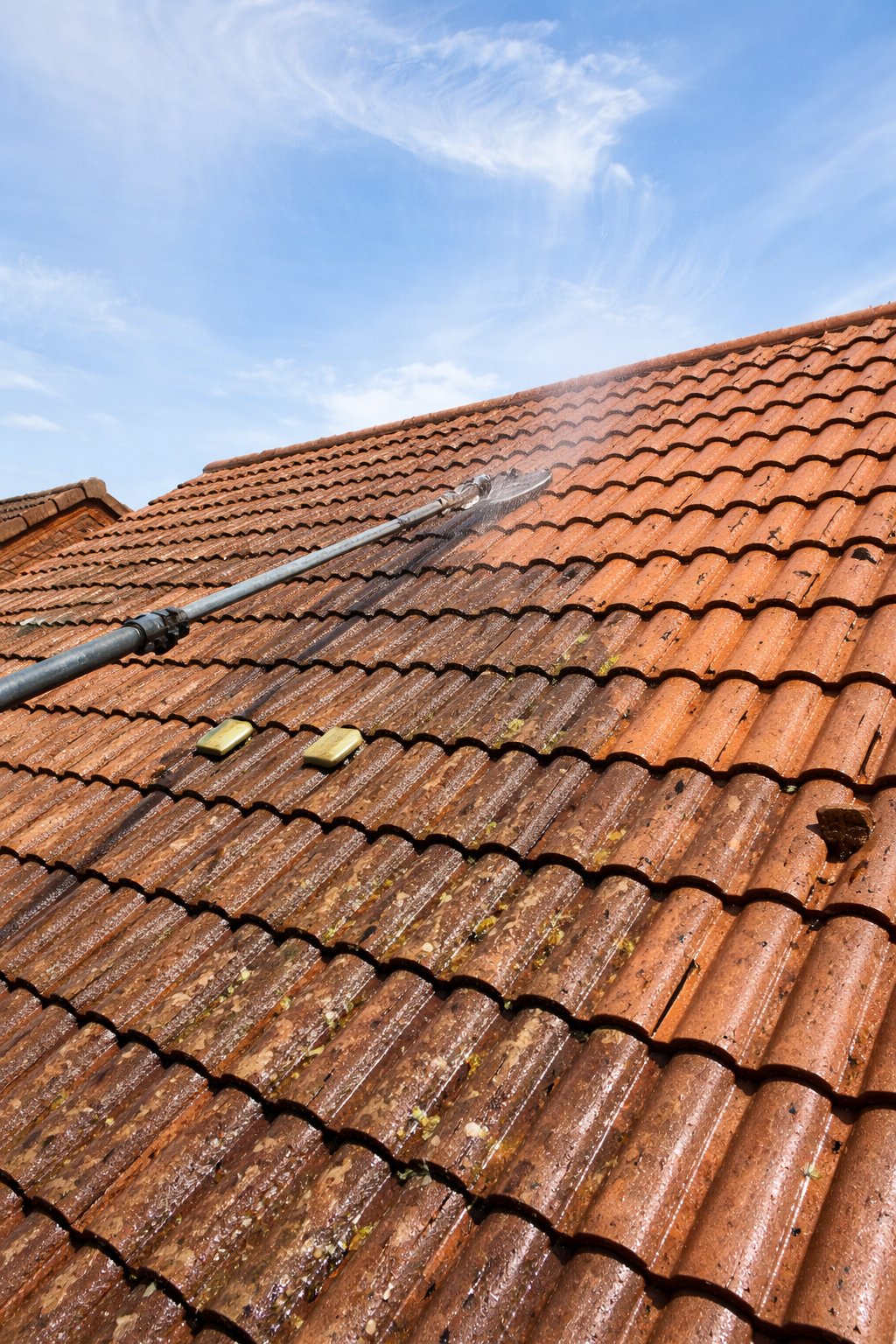
Then there's the local clay. Wrexham sat at the centre of the Ruabon brick and terracotta trade, and plenty of roofs around here still wear Ruabon red clay tiles or ridge pieces. Concrete interlocking tiles, common on post-war estates in Gwersyllt or Llay, behave differently again. Each covering holds moss in its own way and each responds to cleaning at its own speed, so the material under the moss is a real factor in the cost.
3. How much moss, algae and lichen has built up
A light green film is a quick job. A thick, spongy carpet of moss with lichen crusted into the slate is not. The more growth there is, the more time it takes to clear it, and heavy build-up often means a follow-up biocide treatment to kill off the spores left behind.
Wrexham roofs grow moss well, and there's a plain reason for it. The town sits in a damp pocket between the Dee valley and the hills of the Clwydian Range and Dee Valley National Landscape to the west, which catch the weather rolling in off the Irish Sea. North-facing slopes that rarely see direct sun, common on the tightly packed terraces around Rhosllanerchrugog and Coedpoeth, hold moisture for days. All that damp feeds thick growth, and thick growth costs more to remove than a light dusting.
4. Access and safety around the property
Getting to the roof safely is a genuine cost. A cleaner has to think about where ladders can stand, whether the ground is level, and whether the back of the house can be reached at all without going through a neighbour's garden. Terraced streets in Wrexham can be tricky here, with shared yards and narrow rear access that slow everything down.
Height plays in too. A three-storey townhouse near the town centre may need extra equipment or even a tower to reach the ridge safely, and some homes on the steeper streets around Brynteg and Bwlchgwyn add awkward slopes to the mix. And if there's a conservatory, extension or fragile lean-to below the working area, extra protection has to go down first. The harder and slower the safe access, the more the job reflects that.
5. The condition and age of the roof
An old roof needs a lighter touch. Many of Wrexham's terraces date from the coal-mining boom of the late 1800s, built quickly for pit families when the Denbighshire coalfield was at full tilt. More than a century of North Wales weather leaves slate softer, nails rusted, and mortar loose. Cleaning a roof in that state means working slowly and checking for cracked or slipped slates as you go.
A newer, sound roof can be worked more quickly and simply. But an aged one, or one that's been left for years, often turns up small problems that need pointing out before or during the clean. That extra care and inspection is part of what you're paying for, and honestly, it's the part worth having.
6. Extras: gutters, treatments and repeat visits
Roof cleaning rarely happens in isolation. When moss comes off a roof, a lot of it ends up in the gutters, so gutter clearing is often bundled in. If your downpipes have been blocked through a few wet Wrexham autumns, that's more work than a quick scoop.
A biocide or moss-inhibiting treatment is another common add-on, applied after cleaning to slow regrowth. Some homes, especially heavily shaded ones near the wooded Clywedog valley, benefit from a planned repeat visit down the line. Each of these choices is yours, but each one shapes the final figure.
- Roof size and pitch: more area and steeper slopes mean more time and more careful footing.
- Covering type: old Welsh slate and Ruabon clay need gentler handling than modern concrete tile.
- Moss level: a thick, established carpet costs far more to clear than a light film.
- Access: awkward rear yards, height and fragile structures below all add time and equipment.
- Roof age and condition: fragile mining-era roofs need a slower, more watchful approach.
- Add-ons: gutter clearing, biocide treatment and repeat visits all factor in.
Frequently Asked Questions
Can you give me a price over the phone?
Not an accurate one. A cleaner needs to see the roof, or at least clear photos, to judge size, moss level and access. Anyone quoting a firm figure blind is guessing.
Is a bigger roof always more expensive?
Usually, but not always. A small, steep, moss-choked roof with awful access can cost more than a large, simple, low-slung one that's easy to reach.
Does the type of tile really change the price?
Yes. Fragile old Welsh slate and Ruabon clay take longer and need a softer approach than tough modern concrete tiles, and that time shows in the cost.
Why does moss keep coming back on my Wrexham roof?
The damp climate here feeds it. Shade, trees and north-facing slopes hold moisture, so a biocide treatment and the odd repeat visit help keep growth down.
Should I just go for the cheapest quote?
Be careful. A very low price can mean pressure washing that damages old slate, or a rushed job that skips the gutters. Value matters more than the headline number.
Want a clear, honest price for your roof?
Ben's Roof Cleaning works across Wrexham and North Wales, with over 15 years of experience. Get in touch or call 01978 547208
for a free, no-obligation quote.
A fair roof cleaning price starts with a proper look
There's no single number for a roof clean because no two roofs are the same. Your slate, your moss, your access and your gutters all feed into it, and the only way to get an honest figure is to have someone actually assess the roof. Once you know what the factors are, you can weigh up any quote with confidence and spot the ones that are too good to be true.